Ipamorelin research: a medicine file with a gap.
The sequence begins with selective chemistry. The most consequential human paper ends with a missed endpoint.
1998 · A smaller chain, a narrower effect
Ipamorelin began as a modification of GHRP-1: removing its central two-amino-acid segment produced the five-amino-acid sequence Aib-His-D-2-Nal-D-Phe-Lys-NH2. It is wholly synthetic, although it mimics ghrelin at the GHS-R1a receptor. That receptor sits on the pituitary cells that release growth hormone; activating it triggers a calcium-driven release signal.
The founding characterization tested rat pituitary cells, anaesthetized rats and conscious swine. Growth-hormone release remained potent, while ACTH and cortisol did not rise above GHRH-induced levels even at more than 200 times the growth-hormone ED50. In swine the ED50 was 2.3 ± 0.03 nmol/kg, compared with 3.9 nmol/kg for GHRP-6.
I like the subtraction in this origin story. The distinguishing achievement was not simply more hormone; it was removing unwanted spillover. These were acute preclinical experiments, however. Their success did not complete the work of establishing a medicine.
1999 · A pulse in human volunteers
The pharmacokinetic study in healthy male volunteers used n=8 per dose level and five 15-minute intravenous infusion levels from 4.21 to 140.45 nmol/kg. It found dose-proportional kinetics, clearance of 0.078 L/h/kg and a steady-state volume of distribution of 0.22 L/kg. The terminal half-life was approximately 2 hours, and the growth-hormone response was a single pulse peaking around 40 minutes.
In the same year, adult female rat experiments found longitudinal bone growth at 42 micrometers/day with vehicle, rising to 44, 50, and 52 micrometers/day in the ascending-dose groups, without a measurable change in total IGF-1. IGF-1 is a downstream growth signal associated with the growth-hormone axis. I resisted the assumption that a growth-hormone pulse must produce a matching rise in that marker once I saw this result.
For ipamorelin laboratory research, these are specific observations in specific settings. The descriptions research compound, research peptide and research products place material in a research context. The dose record preserves which routes and amounts the published studies used.
2014 · A meal was the test
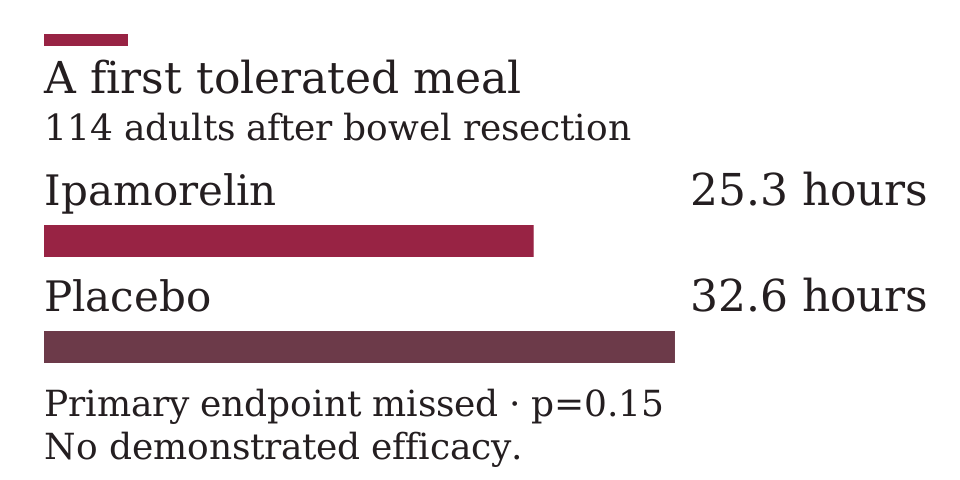
In the published Phase 2 trial for postoperative ileus, 114 adults undergoing bowel resection received ipamorelin or placebo. Median time to first tolerated meal was 25.3 hours versus 32.6 hours, with p=0.15. The primary endpoint was not met; efficacy was not demonstrated.
Treatment-emergent adverse events occurred in 87.5% of the ipamorelin arm and 94.8% of the placebo arm. There was no ipamorelin-specific safety signal in this short perioperative window, which lasted up to 7 days. The population was recovering from surgery; longer-term wellness safety remains uncharacterized.
I give this paper more weight than a tidy mechanism. It asked whether a pharmacological idea improved a practical human outcome, and the result did not establish that it did. The failure does not prove ipamorelin cannot ever help in a different condition. It does prevent me from treating the clinical file as a success story.
2024 · Protecting weight, not losing fat
The cisplatin experiment in ferrets found that intraperitoneal ipamorelin at 1–3 mg/kg inhibited body-weight loss by about 24% on the last day of the delayed phase, 48–72 hours. It did not prevent vomiting; the comparison compound, anamorelin, had a different anti-emetic result.
This is animal research about chemotherapy-associated weight loss. I prefer its awkward specificity to the generic promise of better body composition: maintaining weight during illness and losing body fat are not interchangeable achievements. The appetite and effects file follows that distinction further.
Is ipamorelin FDA approved?
No. Ipamorelin has never been approved as a drug for any indication by the FDA or any other regulatory authority. The clinical trial result and the regulatory question are different parts of the unfinished file.
On FDA's page current as of April 22, 2026, ipamorelin acetate remains in Category 2 for 503B outsourcing facilities and also appears among withdrawn 503A nominations. FDA publishes no withdrawal date. Withdrawal does not authorize compounding or amount to approval. The existing compounding and prescription note sets out that distinction.
Ipamorelin is prohibited in sport at all times under WADA category S2. A research label, a hormone response and prescription access to a compounded blend do not turn it into an FDA-approved drug.